

Sauce Production Line
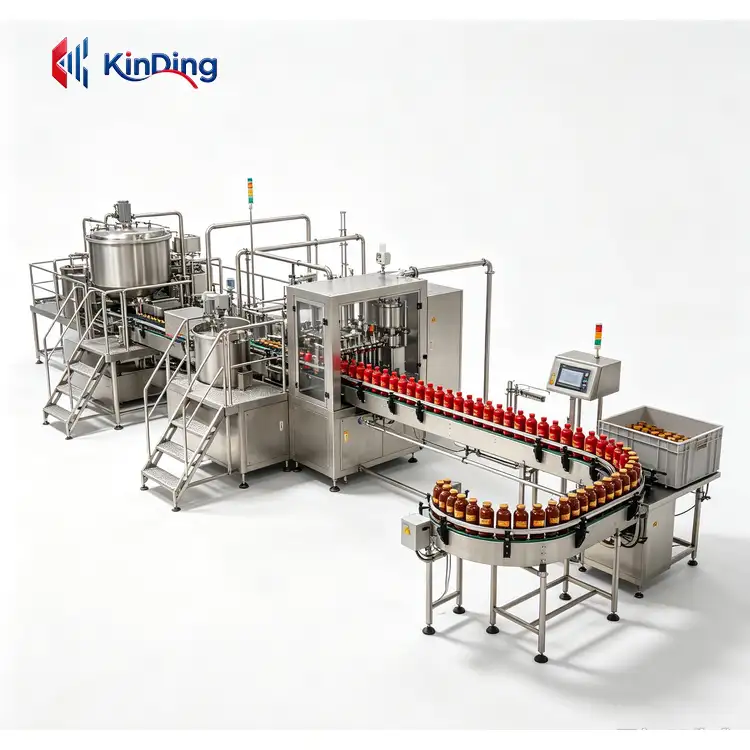
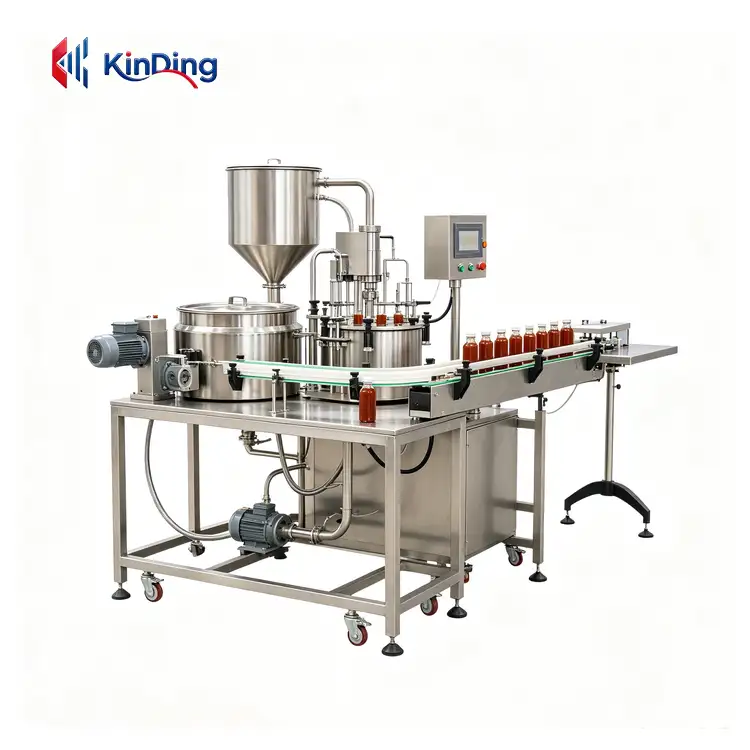
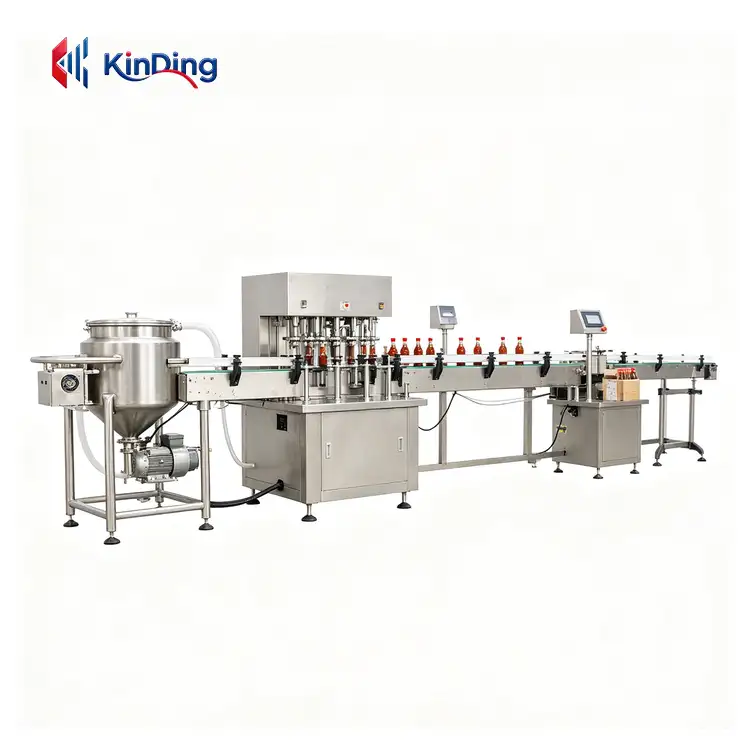
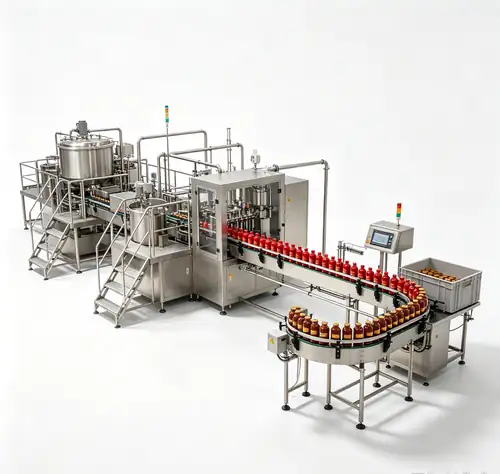
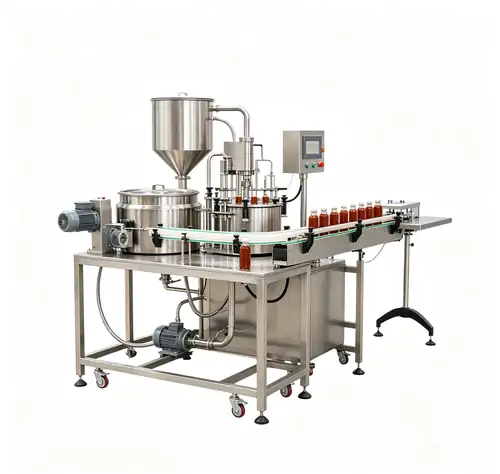
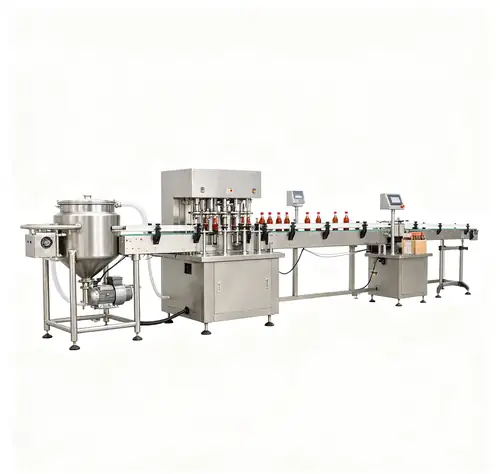
The Kinding sauce production line covers the production needs of various condiments such as tomato sauce, chili sauce, salad sauce, and mayonnaise. The core equipment includes tilting jacketed kettles, vacuum emulsifiers, colloid mills, and sauce filling systems. The industrial-grade Kinding salad sauce vacuum emulsifier integrates vacuum, emulsification, homogenization, stirring, heating, and cooling functions, and is the core production equipment for large-scale food factories and condiment enterprises. The tilting steam jacketed kettle adopts uniform heating technology, completely avoiding local overheating, and is particularly suitable for processing heat-sensitive sauce products. Purchasing Kinding sauce production equipment can provide a one-stop solution from material characteristic analysis to production line layout. All equipment inner walls are mirror-polished without dead corners and are compatible with CIP online cleaning systems. Contact Kinding immediately to obtain customized solutions and technical parameters for sauce processing equipment.
Send Inquiry
Product Description
Sauces are one of the most flavorful and technically demanding categories in the food industry. Whether it's tomato sauce, chili sauce, salad dressing on the table, or hot pot base, pasta sauce, curry sauce, etc., consumers have increasingly higher requirements for taste, quality and safety. Behind this, a well-designed and highly efficient sauce production line is the core force that transforms traditional cooking experience into industrial standards. It is not only a collection of equipment, but also a comprehensive embodiment of food engineering, automation control, fluid mechanics and food safety management.
Firstly, from the perspective of system definition and applicable products, the sauce production line is a complete set of automated systems that integrate raw material processing, automatic batching, mixing and emulsification, sterilization, filling, packaging, etc., specifically serving liquid, semi-solid and high-viscosity sauce products. Its most distinctive feature is the modular structure: different process units can be flexibly combined according to product characteristics, not only meeting the large-scale continuous production of a single variety, but also adapting to the flexible production of multiple formulas in small-scale. Therefore, its application scope is extremely wide, from tomato sauce, chili sauce, salad sauce, peanut sauce, chocolate sauce, to black pepper sauce, barbecue sauce, hot pot base, curry sauce, meat sauce, mushroom sauce, to jam and honey sauce, almost alI in a trance-like state food that undergoes "heating, mixing, homogenization, filling" can find a reliable solution in this system.
Next, we need to deeply understand the core process flow of the sauce production line. The entire production line is usually composed of several key links. The first step is raw material pre-treatment: fresh chili peppers, onions, tomatoes, garlic, etc., are washed, peeled, crushed, pulped, etc., to become the base materials for blending; powder raw materials such as sugar, salt, starch are screened and sorted, and liquid raw materials such as vegetable oil, vinegar, soy sauce are filtered and metered, each ready.
The second step is automatic batching and measurement, the system follows the established formula, through weight or flow measurement equipment, precisely adds various materials, and is controlled by PLC to determine the addition sequence and quantity, ensuring high consistency between batches.
The third step is mixing, shearing and emulsification, which directly determines the taste and stability of the sauce. High-speed shearing and emulsifying machines are suitable for emulsified products such as salad sauce and mayonnaise, forming a fine and stable structure; automatic frying pans are for products such as hot pot base and meat sauce that require frying, giving them unique flavors; colloid mills and homogenizers are used for fiber products such as tomato sauce and jam that require meticulous grinding.
The fourth step is sterilization, based on the acidity, viscosity and heat sensitivity of the product, it can choose pasteurization, UHT ultra-high temperature instantaneous sterilization or scraper sterilization, while retaining flavor and nutrition as much as possible while ensuring food safety.
Finally, the filling and sealing of high-viscosity materials, for different packaging forms, piston, screw or peristaltic pump filling machines each perform their own tasks, combined with insulated hopper to ensure accurate measurement, then through screw caps, sealing or bag sealing to complete sealing, and finally through cooling, labeling, inkjet printing, boxing, palletizing, and ultimately forming finished products on the shelves. It is worth noting that the entire line is also equipped with a CIP online cleaning system, which can automatically cycle clean the pipelines and tanks without disassembly, completely eliminating cross-contamination from the source.
When it comes to equipment composition, a standardized sauce production line can be regarded as a set of precise "orchestral instruments". At the raw material processing end, there are cleaning machines, peeling machines, crushing machines, pulping machines, chopping machines each performing their own duties; in the batching core area, electronic weighing platforms, metering pumps, automatic feeding stations and batching tanks work together; in the mixing and emulsification unit, high-speed emulsifying tanks, double-layer frying pans, colloid mills, homogenizers and vacuum degassing machines jointly shape the texture of the product; and in the conveying section, viscous materials can be smoothly circulated through screw pumps, rotor pumps and sanitary pipelines. The sterilization section is equipped with tubular heat exchangers, scraper-type sterilizers, UHT equipment and cooling towers; the filling area is equipped with piston-type, screw-type or flowmeter-type filling machines, as well as capping machines, sealing machines, etc. The post-packaging section includes labeling machines, inkjet printers, label heat sealing machines, packing machines and palletizing machines, which neatly organize the finished products. All these equipment are uniformly commanded by PLC electrical cabinets, touch screens, sensors and servo drive systems, and are combined with CIP cleaning tanks and automatic liquid mixing systems to form a highly efficient modern sauce factory.
Finally, in terms of selection considerations and development trends, when enterprises plan or upgrade sauce production lines, they must comprehensively evaluate multiple factors. The characteristics of the product itself are the primary consideration, including viscosity range, particle size, acidity and alkalinity, and oil ratio; production capacity scale determines the size and automation level of the equipment; packaging form affects the selection of filling machines and whether heat filling or aseptic filling is required; and special requirements in the process.
In summary, a sauce production line is not just a row of machines and a few pipes; it carries out the transition from the kitchen stove to the modern factory, and integrates traditional flavors with industrial standards. A production line that suits one's own products and production capacity requirements can not only greatly improve production efficiency and product quality, but also provide continuous innovation impetus for the enterprise in the highly competitive market. When a rich and flavorful sauce smoothly rolls off the production line and reaches the dining tables of thousands of households, what we witness is the perfect convergence of food technology and the art of taste.
Related Category
Stainless Steel Tank
Sanitary Pump
Mixing and Emulsification
Colloid Mill
Fruit and Vegetable Machine
Sanitary Manhole
Sanitary Valve
Sanitary Pipe Fittings
Filling Machines
Packaging Machines
Production Line Solutions
Send Inquiry
Please Feel free to give your inquiry in the form below. We will reply you in 24 hours.