

Home > Products > Stainless Steel Tank > Extraction and Concentration > Single-Effect External Circulation Vacuum Concentration System


Single-Effect External Circulation Vacuum Concentration System
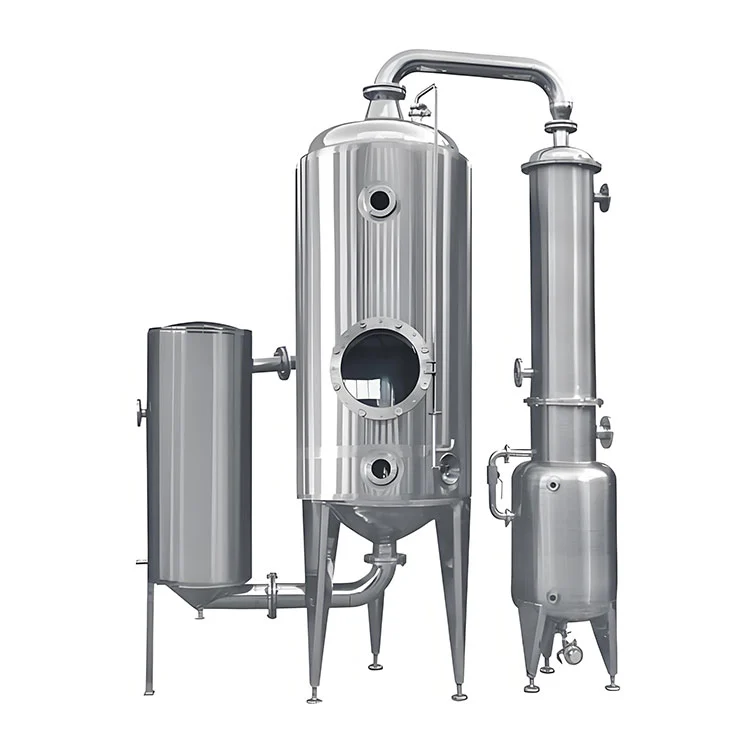
Single-effect external circulation vacuum concentrator. Its main function is to efficiently and gently remove excess water or solvents from solutions (such as fruit juice, herbal extract, chemical intermediates, etc.) to obtain a more concentrated product. The equipment operates under a vacuum (low-pressure) environment, which significantly lowers the boiling point of the liquid and enables low-temperature evaporation. It perfectly protects the activity and flavor of heat-sensitive components. The term "external circulation" in its name refers to the material flowing through a high-efficiency circulating pump outside the tank, which is like installing a "powerful heart" for the evaporation process, enabling faster and more uniform heat transfer and a significant improvement in efficiency.
Send Inquiry
Product Description
Operating principle of the single-effect external circulation vacuum concentrator
Vacuum suction: Start the vacuum system to create a negative pressure inside the entire evaporator. As a result, the boiling temperature of the liquid decreases (for example, water boils at approximately -0.08 MPa vacuum at around 60°C).
Heating and external circulation: The material is drawn out from the bottom of the evaporator by a circulating pump and sent to an external tubular heat exchanger for efficient heating. The heated high-temperature liquid and some steam are then sprayed into the evaporation chamber.
Flash evaporation and separation: After entering the low-pressure evaporation chamber, the high-temperature liquid undergoes "flash evaporation, " and some liquid rapidly vaporizes. The generated secondary steam is quickly captured by the condenser above and cooled into water, which is then discharged. The concentrated material falls back to the bottom and enters the next cycle. This process repeats continuously, gradually achieving the required concentration.

Our commitment
What we offer is a tailor-made concentration solution. From professional selection and design based on your material characteristics (viscosity, heat sensitivity, target concentration), to providing clear installation guidance and operation training. If you have specific material and production capacity requirements, we can provide you with more detailed technical solutions and benefit analyses at any time.
Hot Tags: China Single-Effect External Circulation Vacuum Concentration System Manufacturer , Supplier
Related Category
Storage Tank
Mixing Tank
Emulsifying Tank
Vacuum Emulsifying Machine
Cooling Tank
Jacketed Kettle
Stainless Steel Reactor
Fermentation Tank
CIP Cleaning System
Stainless Steel Sterilizer
Extraction and Concentration
Send Inquiry
Please Feel free to give your inquiry in the form below. We will reply you in 24 hours.


