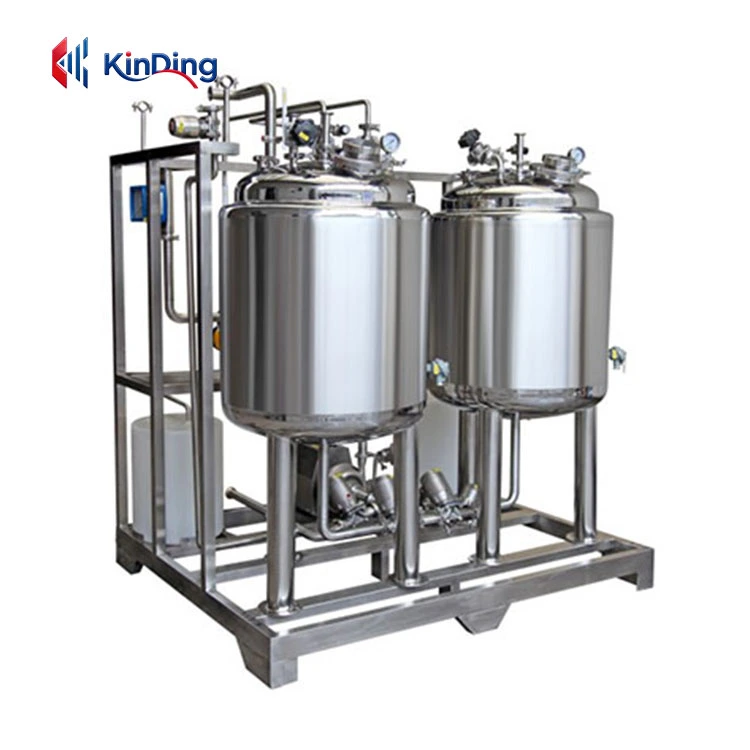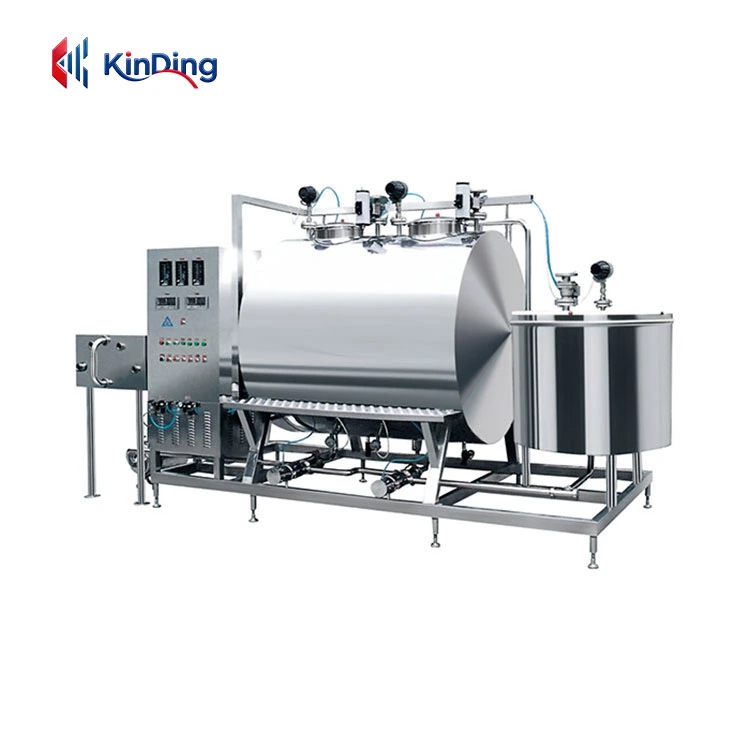
How to choose and use the CIP cleaning system
CIP, or "Clean-in-Place", is a process where the equipment is not disassembled and the cleaning solution circulates inside the pipes and tanks to remove residual materials and kill microorganisms. Many customers initially think that it's just like rinsing with water. However, when actually using it, they realize that there are always some hard-to-clean areas that cannot be thoroughly cleaned. They fail to save water and the cleaning time actually gets longer. The technical content of CIP lies not in whether it can clean, but in whether it can clean thoroughly, stably, and economically.
1. What is CIP cleaning for: All four elements must be present
CIP is not a simple "water rinse". An effective cleaning process relies on the coordinated efforts of four elements: time, temperature, concentration, and mechanical force. These are called "4T" in the industry. Insufficient time means the chemical reaction is not complete; low temperature makes it difficult to dissolve oils and proteins; inaccurate alkaline and acidic concentrations prevent thorough decomposition of contaminants; insufficient pump flow results in no turbulence in the pipes, and the cleaning solution merely glides over the contaminant surface without removing anything.
The mechanical force is the most easily underestimated factor. The flow rate in pipeline cleaning should reach 1.5 to 2.0 m/s to create turbulent conditions and provide sufficient flushing to the pipe walls. The inner wall of the tank is cleaned by spray balls - not just any installation will do. The coverage radius, spray pressure, and installation position of the spray balls jointly determine whether the cleaning solution reaches the tank top and walls. Many cases of incomplete cleaning are discovered when disassembled, with a "dry zone" left on the tank top that has never been sprayed, and the residual materials dry and adhere to it, contaminating the entire batch of products in the next production run.
2. Standard process: Remove organic matter with alkaline cleaning, remove inorganic scale with acidic cleaning
The typical CIP process consists of five steps: pre-rinse, alkaline cleaning, intermediate rinse, acidic cleaning, and final rinse. The pre-rinse uses normal temperature or warm water to remove residual materials in the pipes, reducing the contamination load of the subsequent cleaning solution. Alkaline cleaning is the main force, with sodium hydroxide solution circulating at 70-80°C, targeting oils, proteins, and organic residues. Acidic cleaning uses nitric acid or phosphoric acid, with a slightly lower concentration and temperature, specifically for dissolving water and mineral deposits. The final rinse uses pure water or softened water to flush away any acid or base residues until they meet the test standards.
Not all conditions require acid cleaning every time. Tanks and pipelines that merely store vegetable oil or syrup, without a heating process, have very little inorganic scale, and the frequency of acid cleaning can be reduced. Once a week or even longer intervals are sufficient. However,any process involving heating - sterilizers,heat exchangers,and pipelines after high-temperature reactions - acid cleaning must follow. Heating accelerates the deposition of calcium and magnesium salts on the walls,forming hard scale over time. To remove it,equipment must be disassembled.
3. Concentration and temperature: Excessive is not good
Customers often ask: "Isn't a higher alkaline concentration better for cleaning?" The answer is exactly the opposite. Excessive concentration not only wastes the cleaning agent but also corrodes the stainless steel surface and seals. The conventional alkaline cleaning concentration is controlled at 0.8% to 1.5%, and acidic cleaning at 0.8% to 1.2%. Beyond this range, the cleaning effect is limited, while the equipment damage increases exponentially. Temperature also has an upper limit - acid cleaning is generally not more than 60-80°C. Higher temperatures cause the corrosiveness of the acid to sharply increase, and the gaskets and welds cannot withstand it first.
The area where money should be spent is the online detection. Conductivity sensors monitor the concentration of the cleaning solution in real time, temperature sensors keep an eye on the circulation temperature, and flow meters confirm that the pump is operating normally. The continuous recording of these three data allows each batch of cleaning to be documented. Without these sensors, the cleaning effect is entirely dependent on the operator's "stop when the time is up" - today it takes ten minutes, tomorrow it rushes to clean for five minutes. The problem will only occur when something goes wrong, and it's just a matter of when.
4. Poor design, no matter how you clean later, it's all in vain
The effectiveness of CIP depends on 70% in design and 30% in operation. There is a hard criterion for pipeline design: the length-to-diameter ratio (L/D) of the branch pipes should be less than 2. If this ratio exceeds this limit, the end of the branch pipe becomes a cleaning dead zone, and the cleaning fluid cannot reach the bottom. Valve selection is also crucial. The valve chamber of a common ball valve will accumulate material, so replacing it with a sanitary butterfly valve or diaphragm valve will have a straight flow path, resulting in much less residue. The discharge outlet of the tank must be located at the lowest point. For a flat-bottom tank, a side discharge is used, and the bottom always accumulates a layer of material that cannot be removed. Even if the CIP cleaning is done frequently, it cannot recover the lost material.
There is also a detail that is often overlooked: pipeline slope. After cleaning, there should be no residual water in the pipeline. During installation, ensure that the drainage direction has a slope of 0.5% to 1% from the lowest point, and install a drain valve at the low point - otherwise, the residual water will remain in the pipeline overnight, and the next day it will become a breeding ground for microorganisms.
Another detail that is often ignored is pipeline slope. After cleaning, there should be no residual water left in the pipeline. During installation, ensure that the drainage direction has a slope of 0.5% to 1% from the lowest point, and install a drain valve at the low point - otherwise, the residual water will remain in the pipeline overnight, and the next day it will become a breeding ground for microorganisms.
5. Make these points clear when selecting the system
When purchasing a CIP system, it is not necessary to understand the entire set of fluid mechanics, but the following information must be provided to the manufacturer: the total length and maximum diameter of the pipes for cleaning (determining the pump's flow rate and head), the diameter and height of the tank (determining the number and type of spray balls), the nature of the residual materials (whether they are oily, protein-based, sugar-based or mineral salts, determining whether alkaline washing is the main method or a combination of acid and alkali), the daily cleaning frequency and allowable downtime (determining whether the system is single-tank intermittent or multi-tank continuous liquid supply). With these four points clarified, the system provided by the manufacturer is basically compatible with the actual working conditions.
CIP is the "silent" part of food and chemical production - it does not directly produce products, but every time the cleaning is not done properly, it is laying a trap for the next batch of products. Selecting a well-designed system is far more important than buying the most expensive cleaning pump.