Guide for Selecting Stainless Steel Storage Tanks
When choosing stainless steel storage tanks, many customers initially think, "It's just a container for storing things." However, problems often arise not from the tank itself leaking, but from incorrect material selection causing medium contamination, improper positioning of the pipe openings leading to awkward operation, or inaccurate calculation of the foundation resulting in deformation of the tank bottom. The technical content of storage tanks does not lie in "whether they can hold," but in "how long they can be used and how smoothly they can be operated." The following is an overview from five aspects: material, structure, pipe opening configuration, manufacturing details, and installation.
I. Material: Choose 304 or 316L
Stainless steel storage tanks and reaction vessels are different. They do not have the complex stresses caused by stirring and heat exchange, so the material selection is relatively simple. However, there is a bottom line that cannot be broken: whether there are chloride ions in the medium. If the material is for food and beverage storage or for common chemical raw material storage, 304 stainless steel is sufficient. However, if the medium is brine, chlorine-containing solvents, or is placed outdoors in coastal areas (where chloride ions deposit in the air), the surface passivation film of 304 will gradually be destroyed, and rust spots or pitting corrosion may occur. At this time, 316L must be used - it contains 2% to 3% molybdenum, significantly enhancing its resistance to chloride ion pitting corrosion, and is the standard choice for chemical corrosive media and coastal environments.
There is also a detail that is often overlooked: the thickness of the bottom plate and wall plate of the storage tank. The wall thickness of a pressure vessel is not uniform. The bottom of the tank bears the maximum static pressure of the liquid column, and large storage tanks (with a diameter of more than 3 meters) usually have a thicker wall thickness at the bottom than at the top. If the manufacturer makes the entire tank into uniform thin plates to save material, the tank bottom is prone to bulge and deformation after being filled with liquid, and the weld stress is concentrated, laying a foundation for leakage.
II. Vertical or Horizontal: Consider the site and operation habits
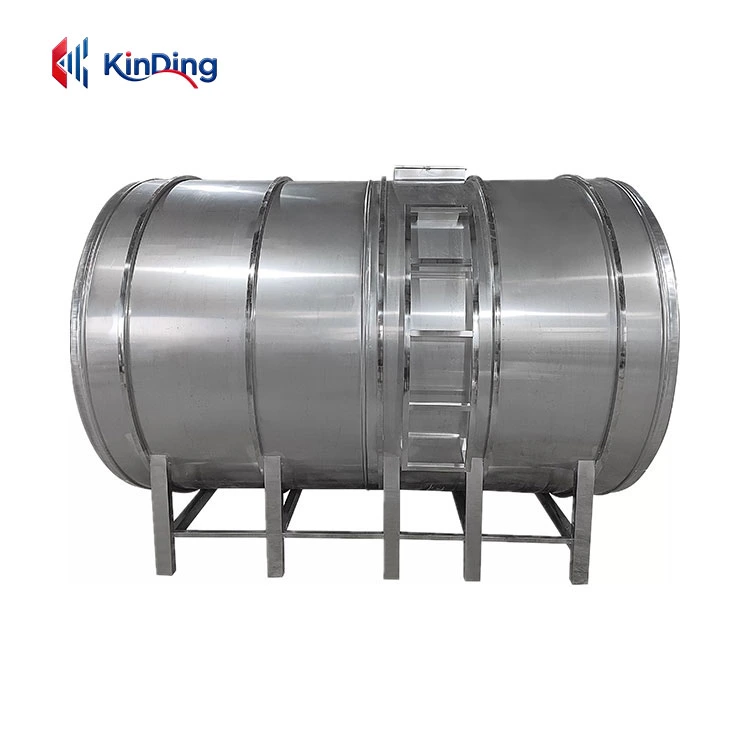
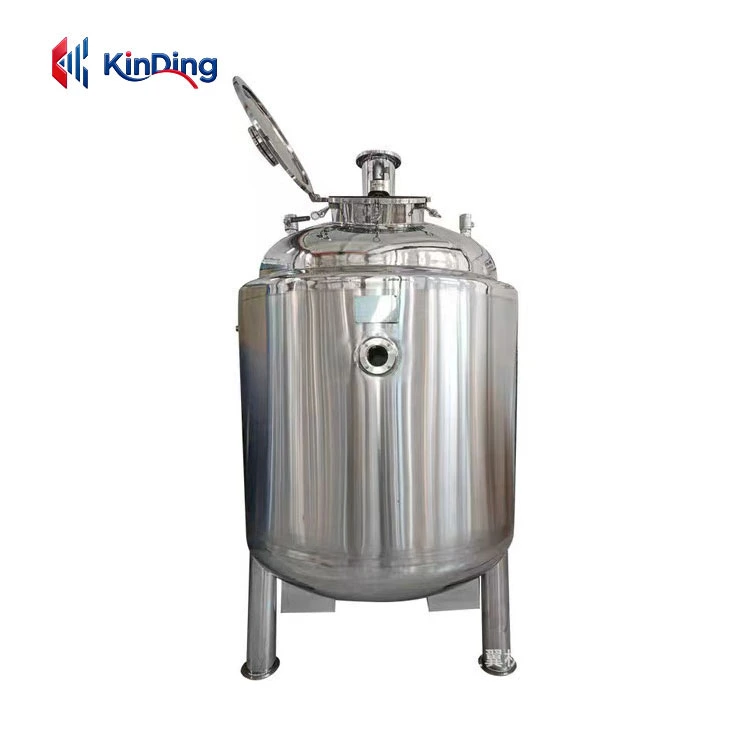
Vertical storage tanks have a small footprint and can have a larger diameter for long-term storage at fixed points within the factory. Their liquid level gauges are intuitive, and the bottom discharge can be emptied by gravity, making daily sampling and cleaning convenient. However, the height is limited - when the factory's net height is insufficient, large-capacity vertical tanks cannot be placed or entered. Horizontal storage tanks have a lower center of gravity and can be flexibly arranged in the length direction, suitable for vehicle transportation, semi-underground installation, or workshops with limited height. However, the liquid level gauges of horizontal tanks need to be arranged along the length direction, and the reading accuracy at low liquid levels is not as intuitive as that of vertical tanks, and there is also more residual liquid at the bottom.
When selecting, measure the site first: for vertical tanks, leave space for the top manhole opening for inspection and lifting, and for installation space. After the tank is in place, leave at least 600-800mm of walkway around it; otherwise, it will be difficult to access for replacing pipe fittings and tightening flanges later.
III. Pipe Opening Configuration: Enough quantity, more important than quantity
Standard storage tanks are generally equipped with 6-8 pipe openings: feed inlet, discharge outlet, exhaust outlet (or breathing valve), manhole, liquid level gauge interface, thermometer interface, and 1-2 spare ports. The number of pipe openings should be sufficient; if a hole needs to be added later on the polished surface, the cost will be several times that of opening it before leaving the factory, and the passivation film at the weld repair site is difficult to restore properly.
The position is more crucial than the quantity. If the feed pipe is inserted directly from the top center downward, it will cause a large amount of foam due to the impact of the material on the liquid surface, and volatile materials will increase the concentration of the gas phase space. The correct approach is to insert the feed pipe into the tank near the bottom or tangentially along the tank wall, allowing the material to flow down against the wall surface, reducing splashing and static electricity accumulation. The discharge outlet should be at the lowest point of the tank, with a conical or butterfly-shaped head and a downward-exposed discharge valve, to be able to discharge completely. Flat-bottom tanks may seem to save space, but the bottom will always accumulate a layer of material liquid that cannot be drained, and over time, it will deteriorate and stink.
Exhaust outlets cannot be omitted. During filling, the air in the tank needs to be expelled; otherwise, the positive pressure inside the tank will make the material fill slowly, or even bulge the tank top; during discharging, if no air is replenished, the negative pressure inside the tank will cause the tank wall to be sucked in. Install a pressure-balancing and fire-extinguishing valve, which can not only stabilize the pressure but also prevent external fire sources from penetrating.
IV. Surface Treatment and Welding: What's the Difference Between Food-grade and Industrial-grade Tanks
Even with the same 304 material, the prices of food and beverage tanks and ordinary chemical tanks can differ by more than 30%. The main difference lies in surface treatment and weld seams. For industrial-grade storage tanks, it is sufficient to smooth the inner wall weld seams, and a surface roughness of Ra ≤ 3.2 μm is considered qualified. For food-grade storage tanks, the inner wall weld seams must be ground to be flush with the base material, and the overall polishing should reach Ra ≤ 0.8 μm. The weld seams also need to undergo acid washing and passivation treatment to restore the passivated film damaged by high-temperature welding. Rough surfaces and unpassivated weld seams are breeding grounds for bacteria, and residues of materials are prone to remain during cleaning.
If your tank is used to store drinking water, food raw materials, or products with cleanliness requirements, this cost cannot be saved. For pure chemical intermediate storage, there is no need to pursue mirror-polished surfaces. Industrial-grade surfaces are sufficient, and the saved budget can be used to thicken the wall plates or equip better level gauges.
V. Foundation and Acceptance: The Tank Works Fine, but the Foundation May Leak
The weight of the stainless steel tank, combined with the full liquid weight, exerts considerable pressure on the ground. A 10-ton capacity vertical tank, when full of liquid, weighs over 12 tons. If the foundation is uneven or insufficient in bearing capacity, the tank bottom will be partially suspended, and after being filled, the bottom plate will sink in, and the weld seams will crack. The concrete foundation must be level (with a deviation of no more than 3 mm per meter), and the area should be at least 200 mm larger than the tank bottom diameter. Large tanks also need to pre-burry anchor bolts or make ring beams.
During the factory acceptance, it is sufficient to conduct a full water test. Fill the tank with clean water, let it stand for more than 24 hours, and check for any leakage at all weld seams and flange interfaces. At the same time, observe if there is any water seepage between the tank bottom and the foundation. Small leaks in the stainless steel weld seams are not noticeable in an empty tank, but they will become apparent when the liquid column pressure builds up.
VI. Selection Checklist for Self-Inspection
Before placing an order, clearly write down the following five answers: What medium will it store, is there chloride ion content? Can it be placed vertically or only horizontally in the site, what is the net height? How many pipe openings are needed, is foam prevention required for the feed? Should the inner wall be polished to food-grade standards? If you choose a large industrial tank, we also need to know if the foundation is concrete or a steel platform. By clarifying these five points, we will provide you with the optimal solution.
Send Inquiry
Related Products