

Guide for Selecting Stainless Steel Reactors
When choosing a stainless steel reactor, the two most common mistakes are: one is selecting the wrong material, which leads to corrosion and perforation within a few months; the other is mismatching the mixing and heat exchange configurations, resulting in doubled reaction time and high energy consumption. Many customers have process parameters but don't know how to convert them into equipment language. In fact, focusing on five dimensions - material, volume, mixing, heat exchange, and sealing - will complete the selection process by more than half. The following will break down each point to help you avoid the most common pitfalls.
1. Material: First, consider the medium, then the temperature.
304 stainless steel is the starting point for most scenarios, resistant to general organic acids, weak bases, and neutral salt solutions, suitable for common chemical, food, and water treatment applications. However, it has a weakness - if there are components such as chloride ions in the material, we recommend choosing 316L, which contains molybdenum and has a significantly stronger ability to resist chloride ion corrosion, being the standard configuration for chemical and seawater environments.
Temperature also needs to be considered. When the reaction temperature exceeds 500°C for a long time, 316 stainless steel is more suitable than 304 stainless steel, as it contains titanium and can prevent material performance degradation at high temperatures. If unsure, provide the medium composition and temperature to the manufacturer for corrosion assessment, which is much more reliable than making a decision on your own.
2. Volume: The loading coefficient is key
"Should I buy a 3-ton reactor for 2 tons of material?" This question cannot be answered based on intuition. Reactors cannot be filled to the brim; they are generally filled to 60% to 80% to leave space for material boiling, foaming, and stirring vortex. For 2 tons of material at a 0.7 loading coefficient, approximately 2.86 cubic meters are needed, and a 3000L reactor is reasonable; if the material is prone to foaming, the coefficient should be reduced to 0.6, and a 4000L reactor should be selected.
The number of reactors also matters. For intermittent operation with long reaction times, two small reactors operating alternately are often more efficient than one large reactor - one reactor is in operation while the other is discharging and cleaning to avoid production waste. For continuous operation, large single reactors are preferred, with fewer interfaces and stable temperature control.
3. Mixing: Viscosity determines the impeller type, and the purpose determines the details
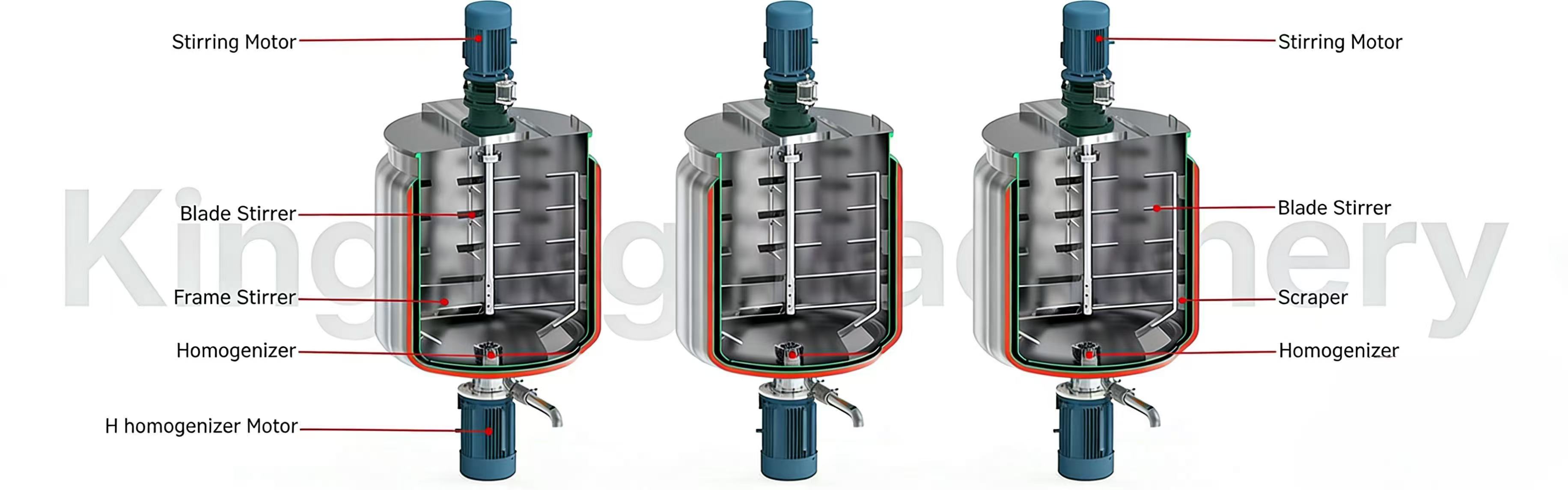
Choosing the wrong mixing method can result in a doubled reaction time. For low-viscosity materials (water, solvents, dilute solutions), use propeller or helical blades with a rotational speed of 200 to 500 rpm, which have a large circulation volume and low energy consumption. For medium-viscosity materials (emulsions, suspensions, syrup-like), use anchor or frame blades with a rotational speed reduced to 80 to 200 rpm, which scrape against the wall to prevent local overheating and scaling. For high-viscosity paste-like substances (resins, adhesives), a helical blade must be used; it forces the material to rotate axially, and ordinary blade types cannot do this.
Two professional details are also worth noting. For gas-liquid reactions (such as hydrogenation, oxidation), use a disc turbine type; its shear force can break bubbles and increase contact area; for crystallization processes, a low-rotational-speed, large-diameter frame blade is required to avoid breaking crystals. Clearly state the material viscosity and reaction purpose, and the manufacturer can provide a suitable mixing system.
4. Heat Exchange: Temperature determines the method, efficiency determines the structure
The heating method follows the temperature. Below 100°C, hot water or low-pressure steam jacket is sufficient; for 100 to 180°C, use saturated steam; above 180°C and not wanting to use a high-pressure system, circulating thermal oil is the mainstream choice, with a wide temperature control range, from -50°C to 400°C. Electric heating is suitable for small-scale production, with high temperature control accuracy, but the operating cost is higher than steam and circulating thermal oil, and it is not cost-effective for large volumes.
Structurally, the jacket is simple and easy to maintain, but the heat transfer area is limited, and large reactors heat up slowly. If rapid heating is required or strong exothermic reactions need emergency cooling, the efficiency of the inner coil is 30% to 50% higher than the jacket, but it occupies more space in the reactor and cleaning is slightly more troublesome. For strong exothermic reactions, it is best to use a jacket with an inner coil channel, allowing flexible switching between cooling and heating.
5. Sealing and Details: Leakage is the biggest hidden cost
Sealing is determined by two factors: pressure and the danger of the medium.
At normal pressure, the materials are non-toxic and odorless, and the packing seal is inexpensive and sufficient. However, if there is pressure (even as low as 0.3 MPa), vacuum extraction, or the materials are flammable, mechanical sealing is the minimum requirement. A single end face is suitable for general conditions, while a double end face is more reliable but requires a sealing liquid system, and the cost and maintenance requirements are one level higher.
Three details are easily overlooked. Discharge valve: Ball valves are cheap but prone to residual materials. For viscous materials, choose the downward-flow type discharge valve to discharge cleanly. Reactor body form: Open reactors below 5000L are convenient for cleaning, while closed reactors are selected for large volumes or pressurized conditions, which are more reliable in sealing and have lower manufacturing costs. Number of pipe openings: The standard configuration is usually six openings. If there are special feeding or detection requirements, clearly list the interface specifications in advance, and add new openings later, which is expensive and affects sealing.
Checklist for Model Selection
Before placing an order, please organize these five answers into one page and send it to us: Are there chloride ions or strong acids in the materials? What is the loading coefficient, and should a bubble space be reserved? What is the viscosity, and is the reaction purpose for mixing or gas-liquid contact? What is the upper temperature limit, and should rapid cooling be required? Is the pressure normal or pressurized, and can the medium leak? We will provide you with the most suitable solution.


