

How to choose between a mixing tank and an emulsifying tank?
In the food, cosmetics or chemical production industries, stainless steel mixing tanks and emulsification tanks have similar appearances and are often confused with each other. However, their core missions are completely different: one is good at "mixing", while the other specializes in "fine grinding". Choosing the wrong equipment not only wastes investment but may also lead to product stratification, rough particles, and shortened shelf life. The following will explain the differences from three dimensions: principle, structure, and effect.
1. Core principle: Macro mixing vs. Micro shear
The logic of the stainless steel mixing tank is macro convection. It relies on the rotation of the impeller (blade type, anchor type, or frame type) to push the entire tank of materials to generate a large circulation. It is like using a spoon to stir coffee, aiming to distribute different components evenly throughout to prevent sedimentation or assist heat transfer. It does not change the particle size of the materials themselves, only responsible for keeping them "together".
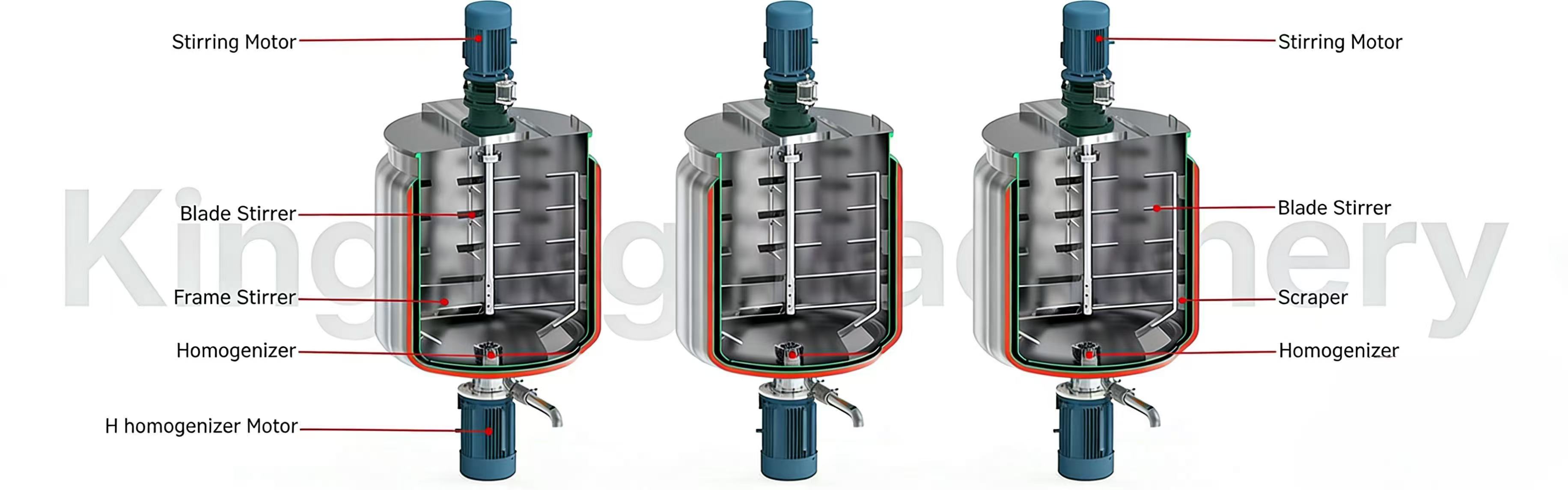
The core of the emulsification tank is micro shear. Its secret weapon is the bottom rotating stator emulsification head. The rotor rotates at a high speed to generate a strong suction, drawing the materials in and rapidly spraying them towards the fixed stator. The materials are in the extremely narrow gap between the rotating stator, subjected to intense shear, collision, and tearing forces, being forcibly broken into micrometer or even nanometer-sized tiny particles. Simply put, the mixing tank is for "mixing oil and water together", while the emulsification tank is for "making oil and water inseparable", forming a stable emulsion.
2. Speed and structure: Slow work for fine results vs. High speed for fine materials
The rotational speeds of the two are not in the same order, which directly determines the differences in equipment construction.
The stainless steel mixing tank is usually a low-speed equipment. The conventional rotational speed is often between 40 to 150 rpm (such as the range of 35 rpm to 150 rpm is relatively common). Because the rotational speed is low, the motor power is relatively small, and the design of the motor shaft and impeller mainly considers rigidity and circulation flow rate, and the shaft seal requirements are relatively relaxed.
The emulsification tank is a high-speed equipment. The rotational speed of the emulsification head is usually up to several thousand rpm (such as 2800 rpm or 2900 rpm). This high rotational speed brings extremely strong shear force. To support high-speed operation, the motor power of the emulsification tank is significantly larger, the main shaft requires higher processing accuracy, and the shaft seal must be very reliable to prevent material leakage or the intake of outside air during high-speed rotation.
3. Effect and selection: Which type do your products need?
Look at an intuitive indicator: Do you want the output to be "uniform mixed liquid" or "fine emulsified liquid"?
If you are producing syrup, thick beverage concentrate, simple salt solutions, or merely dissolving powder into liquid while maintaining suspension, the mixing tank is sufficient and more cost-effective with lower energy consumption. It ensures that the materials do not settle at the bottom and maintains uniform temperature.
But if you are producing mayonnaise, salad dressing, face cream, ointment, stable milk beverages, or needing to fully hydrate and dissolve gels (such as CMC, xanthan gum), you must use the emulsification tank. Because ordinary mixing cannot open the particle size of the gel, it will form "fish-eye" lumps; only high shear force can break the oil droplets to a sufficient size, allowing the emulsifier to firmly encapsulate and prevent stratification and precipitation during the shelf life.
4. Practical suggestions for purchasing customers
When selecting, in addition to looking at the product form, pay attention to one detail: emulsification tanks usually have the functions of the mixing tank, but the mixing tank cannot do emulsification work.
Many emulsification tanks are designed as "double-axis" structure: a slow scraping wall mixing impeller is responsible for overall circulation and wall scraping to prevent adhesion, and a high-speed emulsification head is responsible for bottom shear. If you have both mixing and emulsification requirements, a double-axis emulsification tank can handle it. But if you only bought an emulsification tank for mixing, the high shear may excessively damage the molecular structure of some heat-sensitive materials or break the particles that should not be broken too finely, thereby affecting taste or filtration performance.
In summary: When choosing a mixing tank, consider the volume, mixing method, and whether it has a jacket for temperature control; when choosing an emulsifying tank, consider the power of the emulsifying head, the rotational speed, and the precision of the fixed and rotating parts. Clearly define the final state your material needs to be in, and it won't be difficult to make a decision between these two types of equipment.
Send Inquiry
Related Products

