How to select the mixing tank according to your needs
The four-step method for selecting a mixing tank
When choosing a mixing tank, many customers' first reaction is "I need a tank with a certain volume." However, volume is the result, not the starting point. Similarly, a "2-ton mixing tank" is used for both ingredient mixing and fermentation, but the impellers, motors, and materials inside may be completely different. The core logic of selection is actually only one: First, figure out what you want the material to do in the tank, and then reverse-engineer the tank structure and mixing configuration.
Below, we will break it down from four key dimensions to help you clarify your thinking.
Step 1: Reverse the impeller type based on the "mixing purpose"
The soul of the mixing tank is the impeller, not the tank itself. Before choosing the impeller, answer this question: Do you want the material to mainly flow in a circular motion or undergo shear dispersion?
If the purpose is mutual dissolution of liquids, solid suspension, or prevention of precipitation, you need axial flow impellers with high circulation volume and low shear force. Propeller (marine propeller type) and inclined blade impellers are common choices. They can suck liquid from the top and push it up along the wall to form a large circulation. In such scenarios, the speed does not need to be very high, but the impeller diameter must be large enough, typically taking 1/3 to 1/2 of the tank diameter, to drive the entire tank.
Conversely, if your process is liquid-liquid dispersion, gas dispersion, or requires breaking up agglomerated particles, you need local high shear. Turbine-type impellers (especially disc-type turbines) generate strong radial jets at the edge of the impeller, cutting liquid droplets or bubbles very finely. However, the cost is that: with the same motor power, it brings less overall circulation volume than the propeller type, and there may be slow zones in the tank.
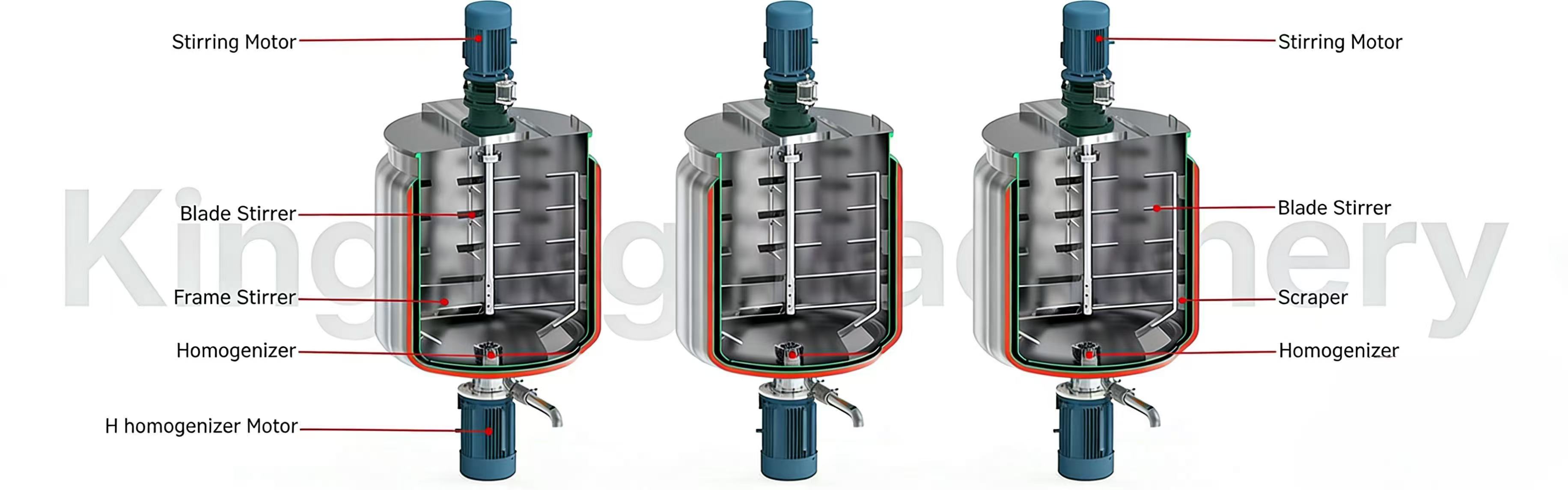
For high-viscosity materials, it's another set of logic. When viscosity exceeds several thousand centipoises, ordinary impellers cannot move them, and anchor-type or frame-type impellers are needed to make the impeller edges close to the tank walls and bottom, constantly scraping away the stagnant layer. If the viscosity is even higher, approaching paste-like, helical-type is the solution. It moves the material as a whole upward and then falls along the wall, forcing the entire tank to participate in the flow, and it is like a conveyor belt.
Step 2: Tank length-to-diameter ratio and loading coefficient
After determining the impeller type, let's look at the tank shape. The most common design is a length-to-diameter ratio of H/D around 1, with a loading coefficient of approximately 0.7 to 0.8. This ratio is balanced between heat transfer, mixing efficiency, and manufacturing cost.
If the process requires high heat transfer (such as needing jacketed heat exchange), the tank can be made shorter and fatter to increase the heat exchange area per unit volume. If the process is gas dispersion (such as fermentation or oxidation reactions), sometimes a higher liquid column height is needed to allow the gas to rise from the bottom to the top for a longer contact time, and the loading coefficient may be increased to 1.5 or higher.
The bottom shape is easily overlooked, but it has a practical impact on the mixing effect. Elliptical or disc-shaped caps are more conducive to fluid flow than flat bottoms, and they are less likely to form dead zones in corners. In the case of solid-liquid suspension scenarios, the bottom corners are prone to accumulating material when using a flat-bottom tank. When selecting the tank, if the material contains solid particles, it is recommended to consider caps with smooth transitions.
Step 3: Material is not necessarily the more expensive the better, it depends on what it contacts
The material selection for the mixing tank is essentially finding a balance between corrosion resistance, cleanliness requirements, and cost.
304 stainless steel is the general starting point, suitable for most food ingredients, common chemicals, and water-based materials. It has good processing properties, controllable cost, and is fully sufficient as a non-directly contacting material support, outer plate, etc. Once the material involves acidic environments or has higher cleanliness requirements, 316L needs to be used. For occasions with hygiene grade requirements, simply choosing 316L is not enough; the roughness of the inner surface, welding quality, and post-treatment of passivation also determine whether the tank is easy to clean and prone to dirt accumulation.
If the materials are highly corrosive and sensitive to metal ions (such as in some fine chemicals or intermediates), glass-lined or plastic-lined options might be more economical. However, glass-lined materials are susceptible to hard impacts and sudden temperature changes. When choosing the type, make sure your process does not involve solid particles or thermal shock.
Step 4: The motor power should not only be "enough", but also "suitable"
Many selection mistakes occur in the motor: the tank is made larger, the agitator is installed, but the motor power is too small. As a result, either the startup trips the circuit breaker or the material does not stir for a long time.
The stirring power is proportional to the cube of the rotational speed and the fifth power of the agitator diameter. This means that a slightly larger agitator diameter will result in a significant increase in power requirements. If you need a large agitator to ensure circulation, the motor power must be left with sufficient margin. Conversely, if the process requires high shear, a small impeller with a high rotational speed configuration may have strong single-time shear, but the overall circulation is weak. If the motor is too small, it won't be able to drive the material, and if it's too large, it may over-shear the material, even breaking crystals or flocs.
A practical judgment method is to ask the supplier to provide a reference value for the power per unit volume (W/m³). For low-viscosity mixtures, typically 40 watts per cubic meter are sufficient, while for gas-liquid dispersion or high shear dispersion, it may require several hundred or even thousands of watts per cubic meter. If your process falls between these two extremes, it is best to verify with pilot-scale data or operational experience from similar conditions instead of simply scaling up proportionally by volume.
In summary: When selecting a mixing tank, the volume is determined last. First, think clearly about what the material will withstand (circulation or shear), what the viscosity is, whether it is corrosive, and what hygiene level is required. Then let these answers determine the agitator type, tank proportion, material, and motor power. Once these questions are clear, you will be more confident when communicating with the supplier and more likely to obtain a tank that truly suits your process.
Send Inquiry
Related Products