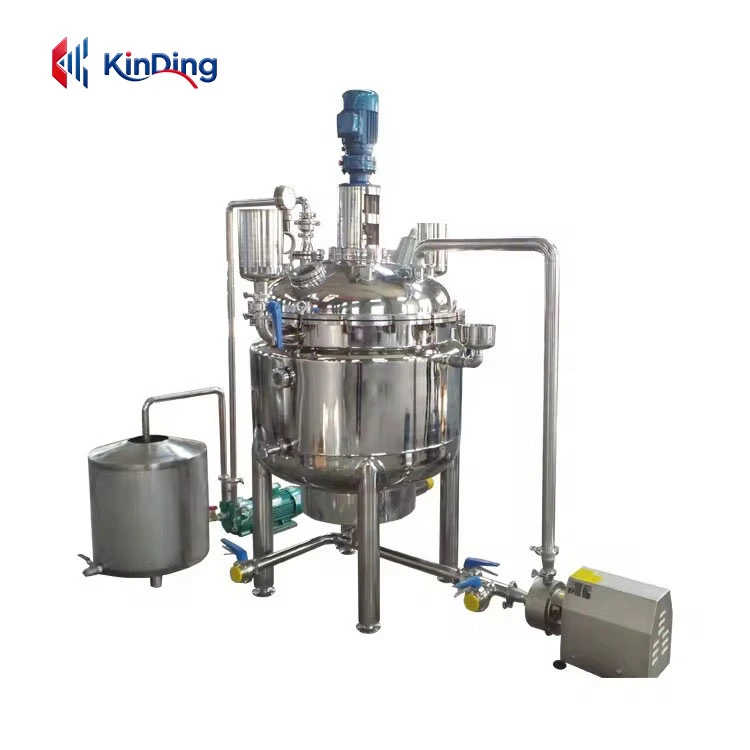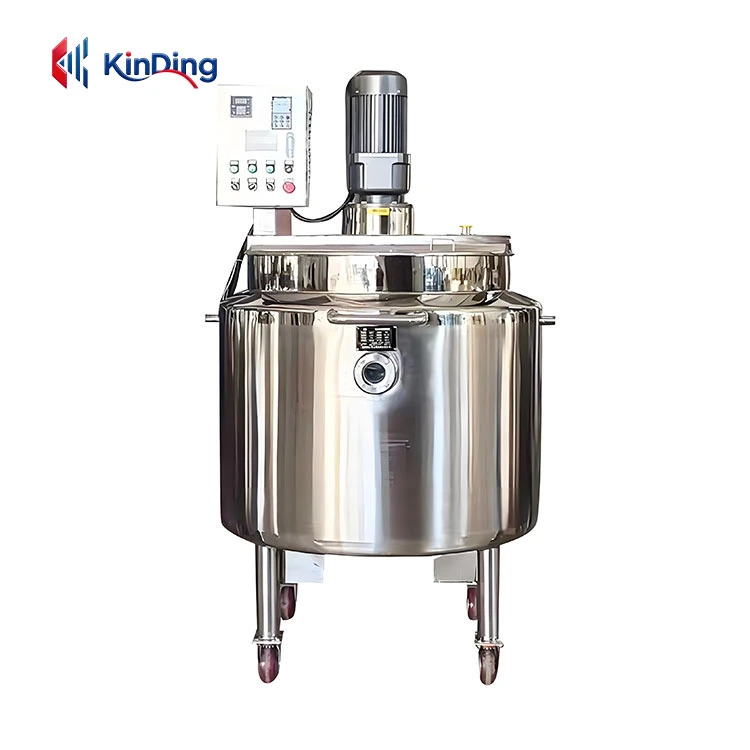


Single Layer Mixing Tank
Welcome to purchase the high-quality single layer mixing tank from Kinding Machinery! This product is made of high-quality SS304/SS316 stainless steel, featuring highly efficient mixing capabilities and durability. It is suitable for stirring various liquids and semi-solids. By purchasing our single layer mixing tank, you can enjoy easy operation, low maintenance costs and fast delivery services. Contact Kinding immediately for a customized quote on single layer agitators to double the efficiency of your production line.
Send Inquiry
Product Description
The Kinding single layer mixing tank has passed the ISO 9001 quality management system certification and CE safety standards, ensuring that the product complies with international norms.
The application scenarios of Single Layer Mixing Tank
It is widely used in the chemical, pharmaceutical, food and beverage and other industries, and is suitable for mixing solvents, suspensions or slurries. For instance, in the production of coatings, it can efficiently disperse pigments; In the laboratory, it can be used for the preparation of small-batch samples.


Instructions for Use of Single Layer Mixing Tank
Before using the Kinding single-layer stirring tank, please make sure to check the power connection and stirring speed Settings. After starting, gradually increase the rotational speed to the recommended value to avoid sudden overload. Daily maintenance includes regular cleaning of the inner walls and inspection of the seals.
If you need, Kinding supports customizing high-performance double-layer mixing tanks for you. The double-layer agitator tank can achieve heating or cooling functions. Compared with the traditional single-layer tank, the advantage of the double-layer mixing tank lies in its interlayer structure, which allows the introduction of steam or cooling media to achieve rapid heating and cooling. Kinding's double-layer mixing tanks are coated with thermal insulation, reducing heat energy loss and helping you save operating costs. Meanwhile, the equipment is equipped with a pressure relief valve and an overheat protection device to eliminate potential safety hazards.


Single Layer Mixing Tank vs. Double Layer Mixing Tank Selection Guide
The single layer agitator tank has a simple structure, focusing on the functions of mixing and stirring. It is suitable for solid-liquid mixing, emulsification and other processes at ambient temperatures, and has the advantages of low investment cost and easy cleaning.The following are key comparisons and selection suggestions:
1. Core difference
Comparison items: single-layer agitator tank, double-layer agitator tank
Single-layer wall structure, double-layer wall without interlayer, with interlayer in the middle (allowing heat transfer medium to pass through).
The temperature control capability relies on an external heat exchanger or an internal interlayer for ambient temperature, capable of heating/cooling (steam, water, oil, etc.)
Low cost, simple maintenance, high cost (complex structure, more materials).
Applicable to the process of mixing at room temperature and reactions without temperature control requirements that need precise temperature control (such as fermentation and crystallization).
2. Key factors for selection
(1) Process requirements
Need temperature control?
Select double-layer: such as chemical reactions, drug synthesis, food fermentation and other processes that require heating or cooling.
Select single-layer: such as simple mixing, dilution, and storage (such as stirring paint, wastewater treatment).
Pressure requirement
The interlayer of a double-layer tank can withstand certain pressure (such as steam heating), while a single-layer tank requires additional pressure vessel matching.
(2) Material properties
Viscosity: High-viscosity materials (such as colloids and pastes) require vigorous stirring. Double-layer tanks can be used in combination with heating to reduce viscosity.
Corrosiveness: For corrosive media, the inner lining material (such as enamel, stainless steel 316L) is required. Both single and double layers are acceptable, but for double-layer tanks, the corrosion resistance of the interlayer must also be considered.
Hygiene grade: Double-layer tanks are preferred for the food and pharmaceutical industries (easy to clean and sterilize).
(3) Cost and Maintenance
Limited budget: Choose single-layer tanks + external heat exchange systems (such as coil or plate heat exchangers).
Long-term operating costs: Double-layer tanks have lower energy consumption (integrated temperature control), but they are more complex to maintain (risk of interlayer blockage).
(4) Space and Installation
Space limitation: The double-layer tank has a high degree of integration, saving space for external equipment.
Flexibility: Single-layer tanks can adapt to various processes through external equipment, making modifications more convenient.
3. Single Layer Mixing Tank Typical Application
The double-layer stirring tank for chemical reactions is precisely temperature-controlled to prevent side reactions.
Double-layer (sanitary grade stainless steel) heating sterilization for food processing, easy to clean.
The single-layer mixing tank for coatings/inks mixes at room temperature and has a low cost.
Pharmaceutical (fermentation) double-layer with aseptic design, temperature control, + aseptic environment.
The single-layer (PP/FRP material) for environmental protection wastewater treatment is corrosion-resistant and does not require temperature control.
4. Other matters needing attention
Heating/cooling efficiency
The interlayer of the double-layer tank has a large heat transfer area and high efficiency, but attention should be paid to the fluidity of the medium (to avoid local overheating).
When connecting the coil to the single-layer tank, it is necessary to calculate whether the heat exchange area meets the requirements.
Mixing Tank Typical application scenarios
The double-layer stirring tank for chemical reactions is precisely temperature-controlled to prevent side reactions. Double-layer (sanitary grade stainless steel) heating sterilization for food processing, easy to clean.
The single-layer mixing tank for coatings/inks mixes at room temperature and has a low cost.
Pharmaceutical (fermentation) double-layer with aseptic design temperature control + aseptic environment.
The single-layer (PP/FRP material) for environmental protection wastewater treatment is corrosion-resistant and does not require temperature control.
In simple terms: To mix, choose a single layer; For temperature control, choose a double-layer. Clarifying your core process requirements is the first step to making the right decision.
Hot Tags: China Single Layer Mixing Tank Manufacturer , Supplier
Related Category
Storage Tank
Mixing Tank
Emulsifying Tank
Vacuum Emulsifying Machine
Cooling Tank
Jacketed Kettle
Stainless Steel Reactor
Fermentation Tank
CIP Cleaning System
Stainless Steel Sterilizer
Extraction and Concentration
Send Inquiry
Please Feel free to give your inquiry in the form below. We will reply you in 24 hours.